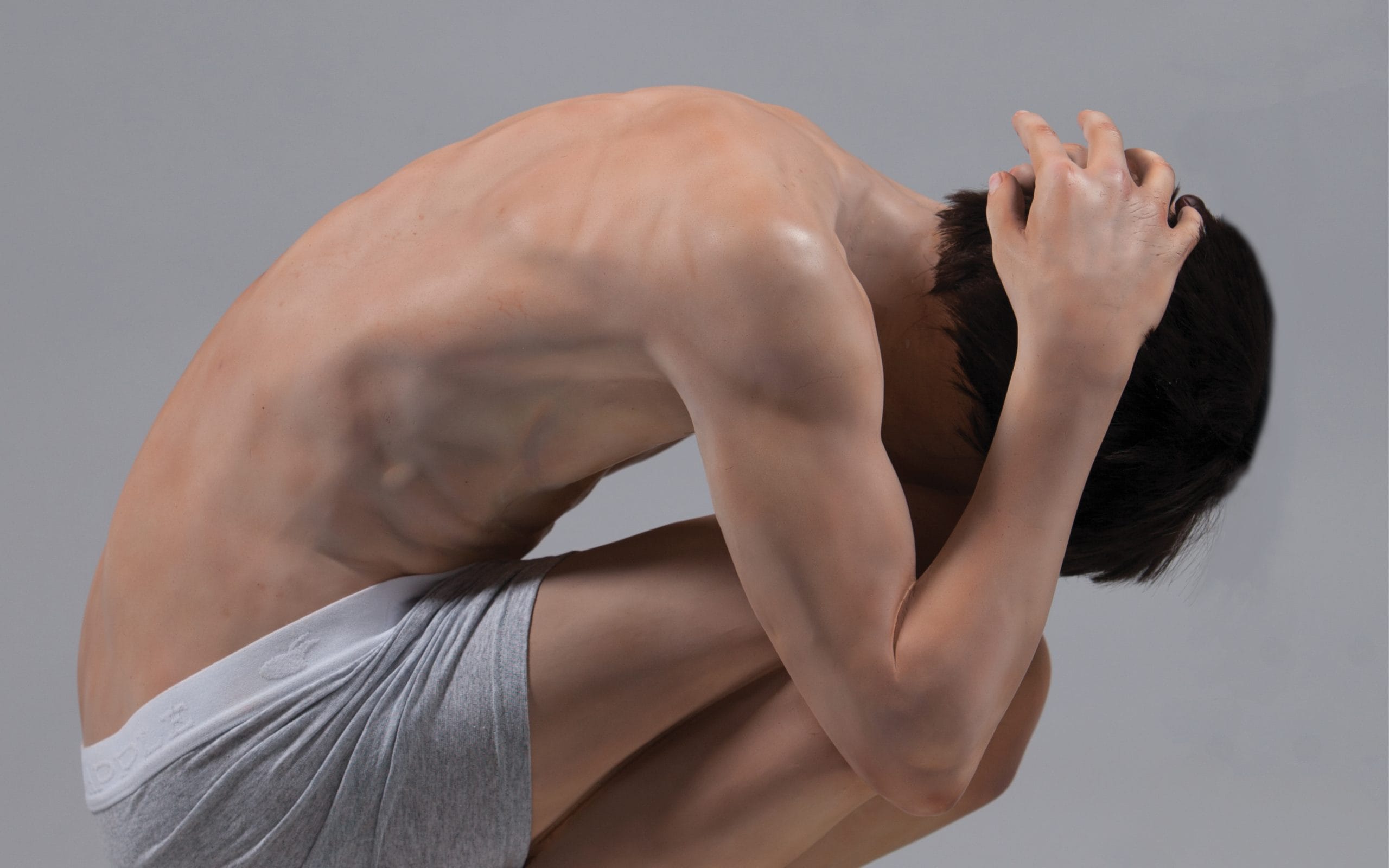
The curatorial concept of thе solo exhibition by Zharko Basheski, one of North Macedonia’s most prominent contemporary artists, is grounded in a thematically focused selection of sculptures through which the body is understood as the primary register of contemporary psychological, social, and existential experience.
The selected artworks neither construct a narrative of an individual crisis nor belong to a moment of acute breakdown; rather, they articulate a continuous state of pressure as a general mode of existence. The sculptures on display were created within a context of enduring instability marked by economic insecurity, environmental threats, and daily exposure to representations of violence. The boundaries between distant devastation, intimate psychological distress, and a sense of powerlessness in the face of events beyond individual control become increasingly blurred. At the same time, the contemporary individual is often denied even the possibility of breaking down; the expectation is to remain constantly functional, present, and useful. Inner destabilisation must be concealed, deferred, controlled, or translated into a tolerable form of everyday functioning. The individual begins to experience the consequences of structural insecurity, the acceleration of everyday life, and the erosion of collective support as personal weakness. Social pressures are thus internalised as personal failure, while the individual is compelled to continue projecting an image of stability even when that stability has been undermined from within. Basheski’s sculptures embody the quiet consequences of this condition, revealing how external circumstances are inscribed in the body through laboured or suspended breath, bodily contraction, exhaustion, and withdrawal. Taken as a whole, the selected works function not as depictions of isolated states but as an inscription of the broader experience of contemporaneity, mapping the modalities of bodily strain rather than just the forms of the body. The power of these sculptures thus lies not in the representation of crisis itself, but in the precise articulation of its prolonged effects on the body.
Throughout 2026, the Museum of Contemporary Art in Belgrade has been developing partnerships with museums and cultural institutions across Europe and the region, creating opportunities for professional exchange, new exhibition projects and connections between museum collections. One outcome of this collaboration is the exhibition ŽARKO BAŠESKI: CORPOREALITY, organised by the Museum in partnership with the National Gallery of the Republic of North Macedonia.
Curated by Zlata Vučetić i Maja Krstevska