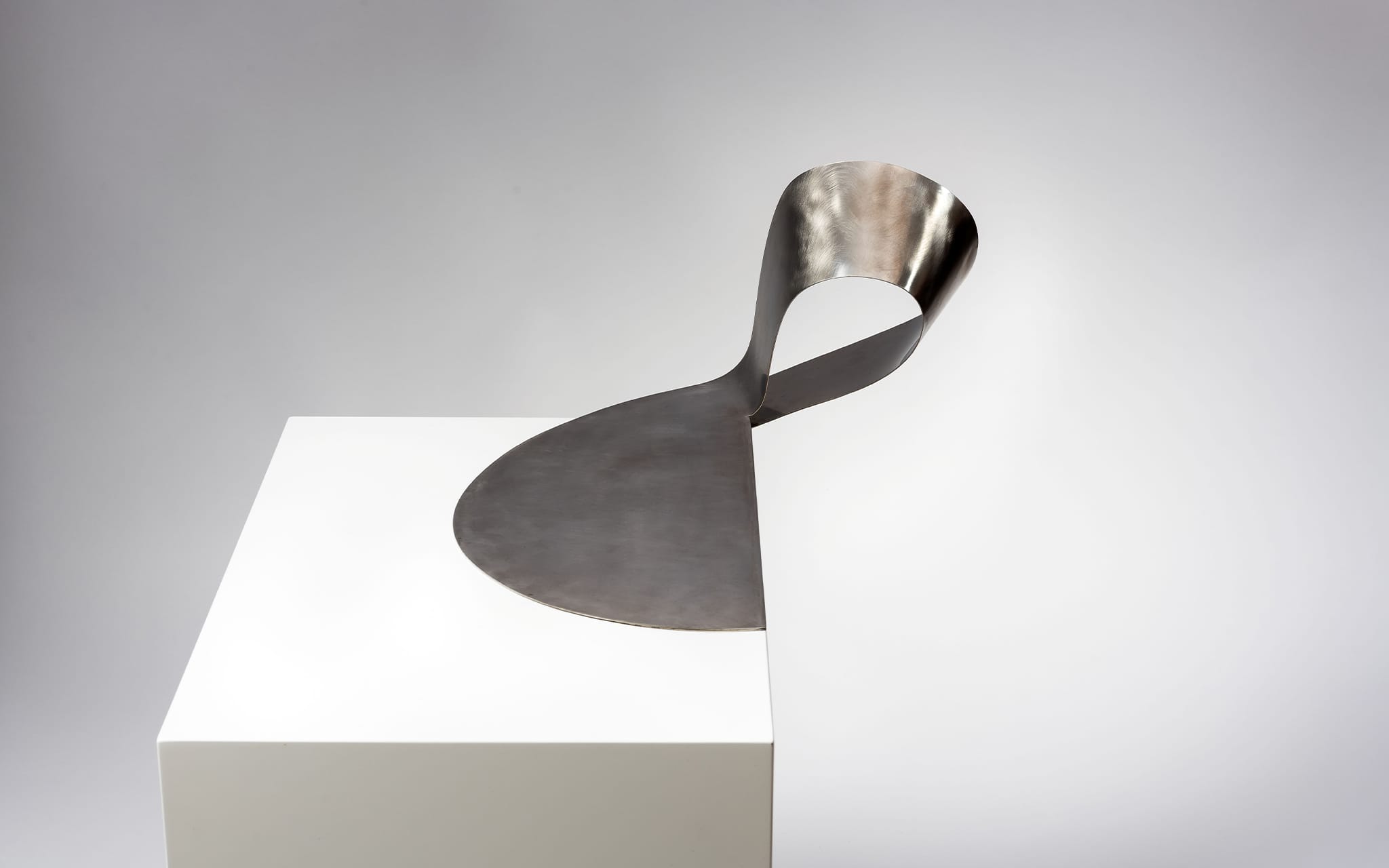
The exhibition at the Gallery Legacy of Milica Zorić and Rodoljub Čolaković offers a comprehensive overview of Saša Pančić’s artistic practice over the past two decades, including his most recent production encompassing objects, sculptures, drawings, and video works.
Since the mid-1990s, Pančić has developed an authentic visual expression grounded in rigorous explorations of the language of abstraction as a complex, open system of forms and signs—one that ranges from the cultural traditions of various civilizations and the philosophical teachings of East and West to avant-garde and neo-avant-garde artistic experiments. At the core of his approach lies the line: a primary agent of construction, conceptual thinking, and the elaboration of his two- and three-dimensional works. Each piece is developed around questions of spatiality, or more precisely, around the relationship and interaction between constructed motifs and the environment in which they are installed and actively perceived. In Pančić’s distinctive vocabulary of vortex-like intertwinings—whether drawn manually or produced through cutting, bending, or other methods—the interplay of surfaces and shaped voids generates perceptually complex works, further enhanced by the semantic potential of the materials he employs. The qualitative properties and expressive registers of metals (steel, corten, stainless steel…), rubber, terracotta, paper, and cardboard become crucial conceptual components. Through processes of material handling and technical transformation, these substances evoke conditions, relations, dynamics, and orders that resonate within broader contexts. Beyond purely visual stimuli, Pančić expands the layered sensory dimensions of the work through its spatial positioning, through light and shadow, and through the viewer’s movement, deepening the work’s communicative field. Within this framework, the artist’s frequent reliance on an achromatic palette is particularly significant. The combinations of planes and backgrounds, and the zones where they meet or separate, introduce the rich symbolic and semantic connotations of black and white, extending the dialogue between material and reflective aspects of the work and opening new spaces for contemplative experience. Spatial integration remains essential for the artist: each piece is intended both as a site of renewed, multisensory encounter and as part of a unified formal whole. Visitors thus navigate an environment of distinct suggestiveness, bringing their own physical and spiritual worlds into dialogue with the forms inhabiting the gallery space. This impression is intensified by Pančić’s video works, which represent both an expansion into a new medium and a continuation of the investigations and poetics present in his drawings, objects, and sculptures. Developed through moving images that function as visual inspections of form and subtle correspondences between textures and materials, these works integrate sound as an additional, purposefully composed layer—one that animates and ultimately reveals the dynamic structures that define Pančić’s practice.
Saša Pančić (b. 1965, Mostar) graduated from the Faculty of Fine Arts in Belgrade in 1989 and earned his master’s degree at the same institution in 1992. He has held independent artist status since 1988 and has been a member of ULUS since 1992. He has exhibited in more than twenty solo shows and numerous group exhibitions in Serbia and abroad, including Greece, Poland, Croatia, Bulgaria, Romania, China, Japan, France, Russia, Finland, and Germany. His works are included in public and private collections such as the National Museum Kraljevo, National Museum Aranđelovac, National Museum Kragujevac, Terra Museum in Kikinda, Zepter Museum, Macura Museum, Telenor Collection, Wiener Collection, Luciano Benetton Collection, Gallery of Contemporary Fine Arts Niš, Pančevo Cultural Center Collection, and Thalberg Gallery Collection, Zurich and Collection of Ronewa Gallery, Berlin. He is also the author of several public sculptures, including works for the Terra Museum, Kikinda; the Sculpture Park of the Center for Visual Education “Šumatovačka,” Belgrade; the foyer of the Belgrade Drama Theater; public space in Sofia; and the Kakslauttanen Sculpture Park in Lapland. His video works have been shown at SEEfest – East European Film Festival, Los Angeles, and the Belgrade Documentary and Short Film Festival.
Project authors: Dr. Rajka Bošković and Miroslav Karić