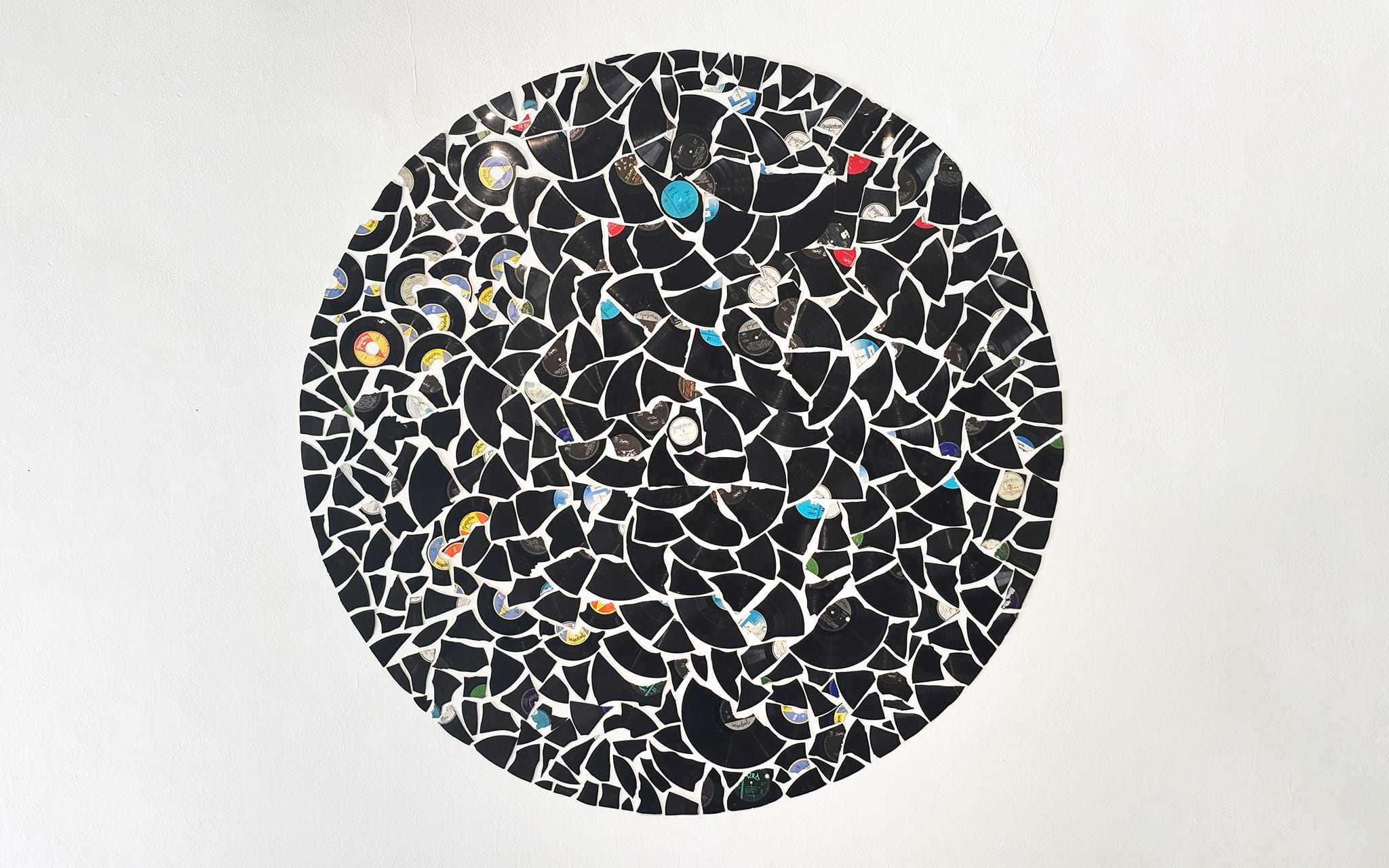
Present already in his first video works and performances, the phenomenon of sound—music, sonic narrative, utterance, sound as a subjective, psychological, and philosophical category, as a carrier of information, speech, energy, physical presence, noise, or the absence of sound—constitutes one of the key segments of Dragan Vojvodić’s multimedia artistic practice.
Sound appears here as an integral component (video art), a correlate or outcome of activity (performance), a form of direct communication with the audience (spoken performance), or as an autonomous artistic medium. Vojvodić’s early interest in alternative and experimental music, as well as his early recognition of the potential of sound, profoundly shaped his sensibility in the field of visual art. The presence of sound, in its variations of form, volume, and intensity, in the artist’s works points to diverse conceptual situations and influences, functioning as a means of interpreting and articulating a wide spectrum of themes—from observations of local and global sociopolitical conditions to narratives of an individual and existential nature. Opening a space in which the auditory is brought into relation with, intertwined with, or set in tension against the visual, Vojvodić frequently refers to figures such as Kazimir Malevich, John Cage, Marcel Duchamp, and Joseph Kosuth, drawing on their artistic procedures and systems of thought as points of departure for questioning the limits of the medium itself and the meaning of the work of art. In the dialogue between historical legacy and personal experience, the artist examines notions of identity, memory, and continuity, weaving them into narratives of contemporary life and artistic contexts. The exhibition at the Salon presents works in a range of media created over the past two decades, which engage directly or indirectly with sound, sound carriers, the production or absence of sound, as well as sound as a performative and conceptual statement.
Installations and objects composed of elements from Vojvodić’s collection of vinyl records and covers, alongside video and audio works in which the sonic landscape unfolds across a spectrum ranging from distorted effects and ambient noise to inarticulate vocal sound, the cacophony of speech and melody, as well as the intentional silence of the gallery space, introduce the viewer to the artist’s distinctive exploration of sound as a perceptual, aesthetic, and cultural experience. In Vojvodić’s case, these experiences have been shaped by the alternative cultural scene of Sarajevo in the 1980s, a disrupted youth and the experience of exile, by the generational cry of those who, in this region, did not live to see a better life, and by frequent travel and geographical displacements: the icy roar of Scandinavian landscapes, the spectral acoustics of Fukushima, and the everyday life of Parisian streets marked by the chatter of cafes and protests of migrant communities.
Dragan Vojvodić (b. 1965, Kula) began his studies at the Academy of Fine Arts in Sarajevo and graduated from the Academy of Arts in Novi Sad. He has exhibited in solo and group exhibitions in Serbia and internationally (MSUV; Salon of the Museum of Contemporary Art Belgrade; MMSU Rijeka; Belgrade Cultural Center; Goethe-Institut Belgrade; Ozon Gallery, Student Cultural Center Gallery, and Museum 25 May, Belgrade; EuropeNow (CES), Columbia University, and Ejecta Project, USA; National Gallery of Bosnia and Herzegovina; MSUCG, Podgorica; Künstlerhaus Museum, Vienna, among others). He has participated in numerous projects and biennials (the Venice Biennale, 60th edition, within Vlatka Horvat’s project at the Croatian Pavilion; Art Encounters, Timisoara; October Salon, Belgrade; Biennial of Art, Pančevo; Missing Stories, Goethe-Institut Belgrade; Risk Change, Novi Sad; 700IS Video Art Festival, Iceland, among others), as well as performance festivals in Serbia, Croatia, Hungary, and Italy. He has taken part in residency and research programs in Greenland, Norway, Sweden, Finland, Japan, the United States, Russia, Estonia, Spain, Portugal, and France, among others. He is a co-founder of the NGO Art Box, Novi Sad.
Curated by Miroslav Karić