The exhibition Time Bombs is a collaboration between the Museum of Contemporary Art Belgrade and the Museum of Modern and Contemporary Art Rijeka. Its title derives from the eponymous video work by the performing arts collective BADco., filmed in the then-abandoned, yet-to-be-renovated spaces of the Rikard Benčić factory, now occupied by the Museum of Modern and Contemporary Art in Rijeka.
The work brings together industrial architecture, sites of defunct production, and spaces in which contemporary artistic practices become institutionalized. Functioning as a kind of footnote, the video serves as one of the points of departure for thinking about the spatial, temporal, and institutional frameworks of artistic practice, entering into dialogue with the work of Marko Tadić and Igor Eškinja, as well as with the documentation and image-object by the artist Ljerka Šibenik, all of which are inscribed in the histories of both the collection of the Museum of Contemporary Art Belgrade and the Museum’s Salon exhibition space. Emerging in part in situ, the exhibition unfolds as a spatial and temporal dramaturgy of traces of the past and present. It interweaves ideas of the archive, material remnants, and exhibition infrastructures, prompting reflection on the relationship between art, the institution, and society, as well as on the potential for their future reconfiguration. The works of Igor Eškinja, Marko Tadić, Ljerka Šibenik, and BADco. come together as a series of interrelations and fissures woven into the exhibition’s provisional environment.
Through a dialogue between older and newer works, and through spatial interventions and gestures encompassing collages, drawings, photographs, furniture, documentation, video, and an object, the exhibition examines how art history and institutional history become inscribed in space, objects, and modes of display, while considering the possibilities for their renewed activation.
What remains of earlier exhibitions – props and furniture, documentation and works held in the collections, elements of museum display, and the artist’s current work – becomes material for establishing new relationships between the work of art, the institution, and its social context. Furniture, the archive, and other elements of museum exhibition practice thus move beyond their customary functions to become visible components of the exhibition’s language. No longer merely neutral supports for works of art, they emerge as material witnesses to the ways in which art is produced, organized, exhibited, and interpreted historically. Within the Salon, these traces encounter echoes of the previous installation, current artistic production, and artistic imagination.
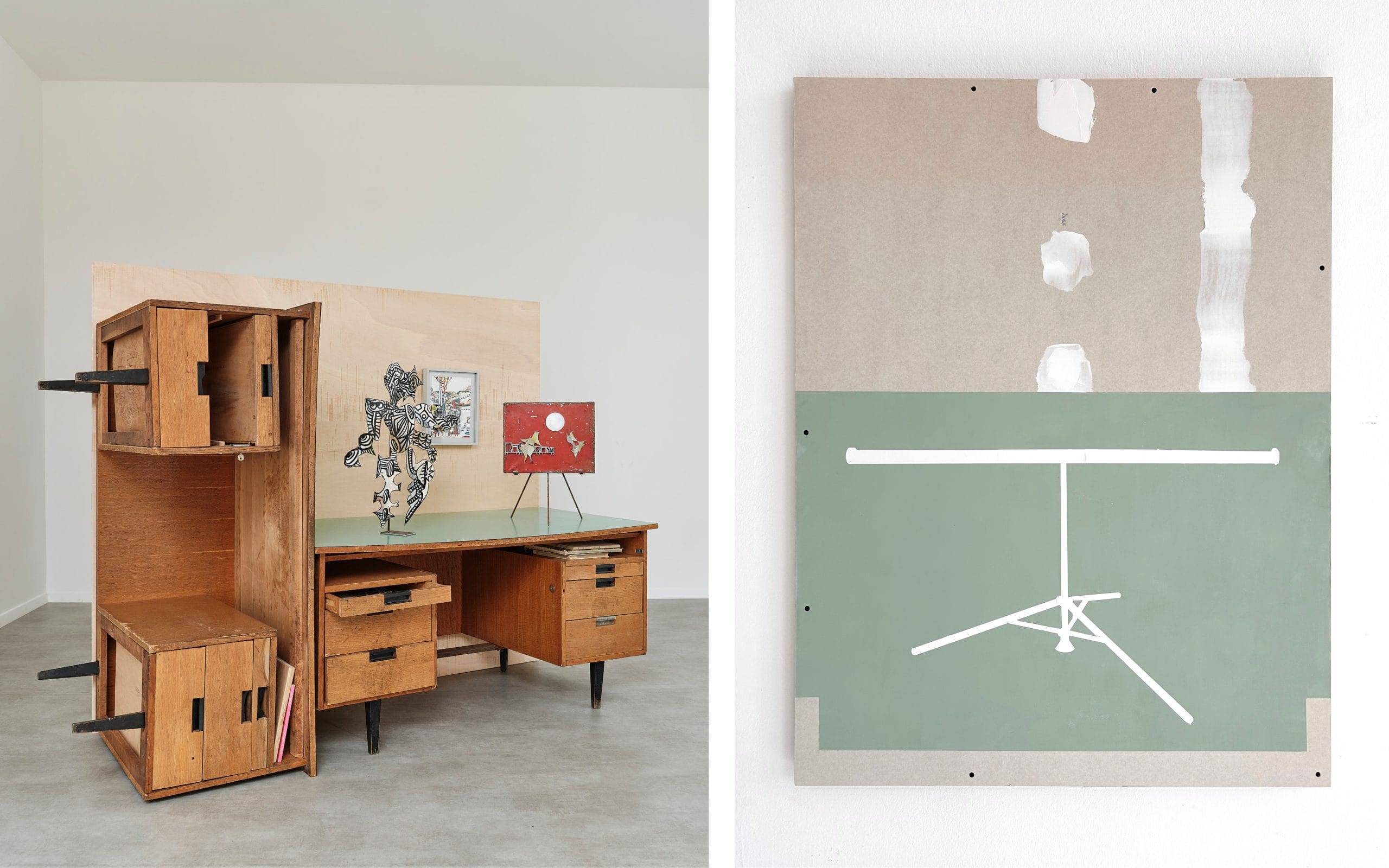
In his work, Marko Tadić brings archival materials, photographs, postcards, and fragments of art history into new relationships through collage and assemblage, opening the possibility of viewing the past as a constellation of fluid, interconnected traces. In recent years, part of his approach to exhibition-making has developed through a reconsideration of conventional modes of display, incorporating elements of furniture and found objects that function as exhibition scenography and as structures for presenting works of art. Through this approach, Tadić brings his own work into dialogue with that of other artists, including, on this occasion, Igor Eškinja’s series of drawings Every Attempt at Liberation Ends in Applause (2008) and Ljerka Šibenik’s Object (1967), from the collection of the Museum of Contemporary Art Belgrade.
In his new works from the series Before the Final Coat, Igor Eškinja explores the relationship between the work of art, its production process, and the conditions of its display, using the surfaces of plasterboard panels and traces of their treatment as sites where working processes are simultaneously revealed and concealed. The digital photographs Etudes of Multiplicity, depicting empty red folders with their covers spread open, evoke administrative and bureaucratic models, while also suggesting the possibility of new inscriptions, meanings, and negotiations. Meanwhile, photographic documentation of Ljerka Šibenik’s 1972 exhibition introduces a historical dimension, connecting the present installation to the exhibition history of the Museum’s Salon. Eškinja’s wall intervention The Materiality of the Image extends Šibenik’s investigations into geometric and constructivist forms, opening up a space for correspondence between different artistic practices and the ways in which visual inquiries are carried forward and reshaped in new contexts.
In its provisional spatial and temporal configuration, Time Bombs offers no stable museum narrative, but rather a situation in the making. Its precariousness means that meaning is not exhausted by what has been preserved; instead, it continues to evolve through changing circumstances, shifts in position, and the activation of new possibilities for connection, bringing into focus art’s potential to contribute to the horizons of social imagination.
In autumn 2027, the Museum of Modern and Contemporary Art in Rijeka will mark ten years of activity in the renovated industrial premises of the Rikard Benčić factory with an expanded version of Time Bombs. In January 2028, it will also commemorate the eightieth anniversary of the Museum’s founding.
Exhibition Curator: Branka Benčić, Director of MMSU Rijeka, in collaboration with Miroslav Karić, curator of the MoCAB Salon
The exhibition was supported by: