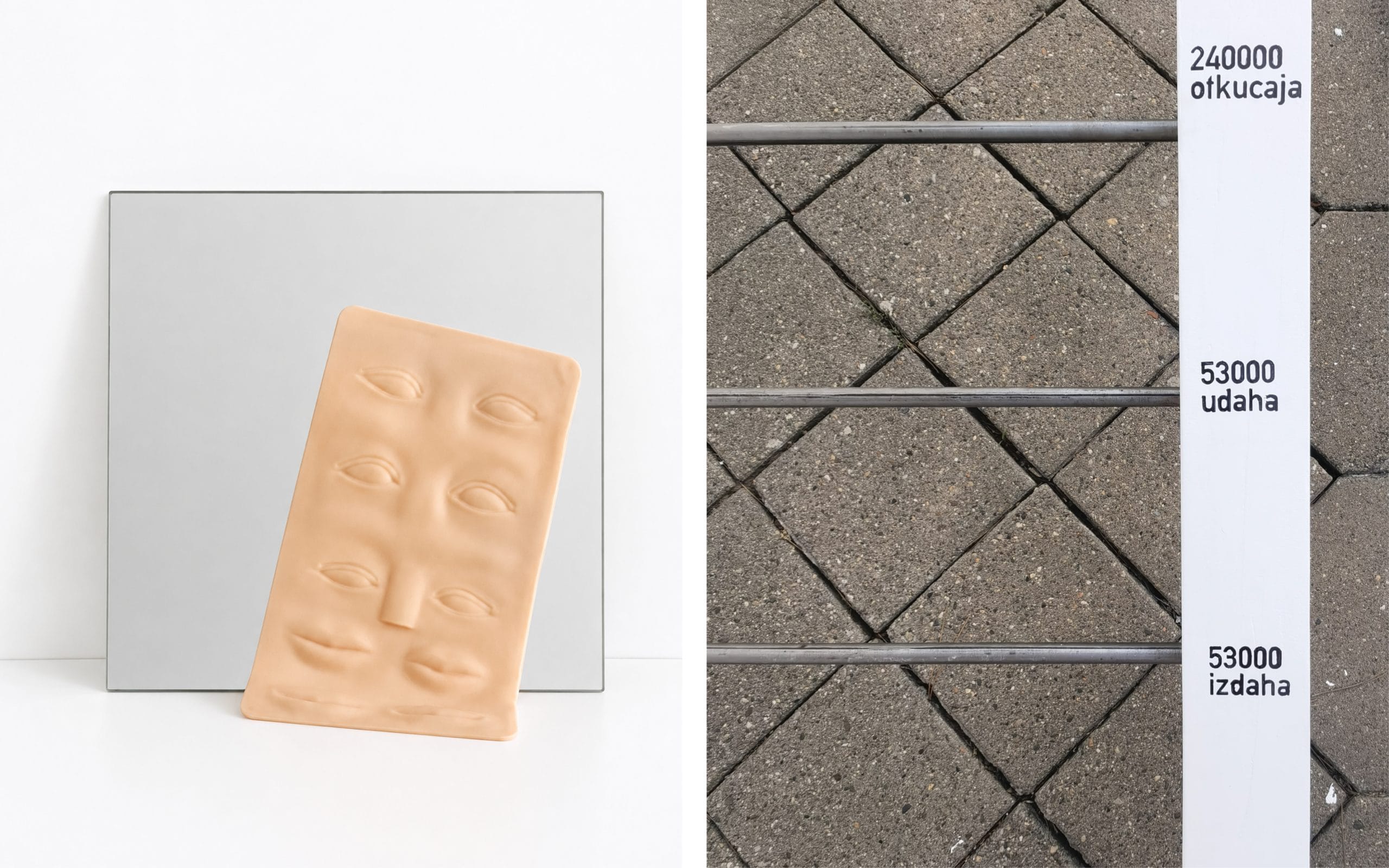
Connected by a critical approach to various phenomena of contemporary society, the artistic practices of Tanja Juričan and Zorica Čolić are based on a strong interest in examining the ways in which social norms and values are shaped, distributed, and reproduced through the body, relationships, patterns of behavior, and everyday life.
Moving the focus from the question of what an individual is to the question of what forms of life, (in)visible mechanisms, and structures enable or limit his/her existence, the artists thematically explore the spaces and boundaries between the bodily and the social, the organic and the artificial, the autonomous and the institutional. While Čolić’s works emphasize corporeality as a shifting category whose meaning is continually constituted through perception, desire, and the regimes of representation of mass consumption and the media, Juričan focuses on material-symbolic forms and practices involved in processes of subjectivization and collective social coding, as well as in the production of social reality. Brought together, indirectly and directly, within the broader field of biopolitical concerns, the artists’ works are also connected by the interdisciplinary nature of their research and by poetics that bring together visual art, technology, theory, and an empirical perspective.
At the Salon of the Museum of Contemporary Art, Čolić and Juričan examine and analyze the social conditioning of our existence and functioning, as well as the frameworks and logics of systemic social norm-setting that become part of our bodily experience and understanding of the world in which we live, both individually and collectively. Investigating different modalities of social existence and the relations into which matrices, rules, and regulations are constantly inscribed, in which they are repeated and internalized, the artists’ works take as their starting point the psycho-affective and behavioral effects of these processes. Through objects and video, Čolić explores the consequences of contemporary capitalism for the human body, pointing to the fact that its boundaries can no longer be clearly separated from technology, medical advances, and the economic and cultural systems that transform and augment it. Her works also question social conceptions of the healthy, functional, and desirable body, which are formalized as a system of values and become part of the subjective perception of one’s own corporeality, desire, and vulnerability, making the contemporary relation to the body a profoundly ethical and political question. Juričan, on the other hand, addresses, through an interactive installation and a group of objects, the ritualized nature of actions and procedures that determine and shape our patterns of behavior and conduct in social situations and conditions marked by uncertainty and risk, as well as their translation into an order of predictability, control, and protection. The artist’s works shed light on transgenerationally inherited social practices and material and linguistic regimes of discipline, whose subtle mechanisms of normativization are continuously reproduced as measures of our conformity with socially expected and acceptable conceptions of the healthy, obedient, and productive subject. Through their artistic practices, Čolić and Juričan open up a space for understanding the broader contexts in which social imperatives and conventions are reflected through micro-experiences, materialized in the body and operationalized in everyday practices of living and interaction, becoming internalized as personal needs, habits, fears, and strategies of self-control.
Zorica Čolić (1977) graduated from the Academy of Arts in Novi Sad and received her MFA in Electronic Integrated Arts from Alfred University in Alfred, New York. Her work has been presented in solo and group exhibitions internationally, including at Elizabeth Foundation for the Arts Project Space, Microscope Gallery, and The Bronx Museum of the Arts in New York; the Museum of Contemporary Art in Leipzig; Energy Museum of Santralistanbul in Turkey; the Museum of Yugoslavia, the Cultural Center of Belgrade, Remont Gallery, and the Belgrade Youth Center, among others. Čolić was an artist in residence at several institutions in New York such as Harvestworks, Whitney Museum’s Independent Study Program, and she was awarded NYFA/NYSCA Fellowship in Digital Arts from the New York Foundation for the Arts. In addition to her studio practice, she is engaged in research, teaching, and curating screenings. Recent projects include curating the screening program (Un)invited Collaborators at Anthology Film Archives and a presentation at the international conference Odorous Object: On the Materiality of Scent at Brown University. She lives and works in New York City.
Tanja Juričan (1980) graduated in painting from the Faculty of Fine Arts in Belgrade and subsequently studied at the Department of Multimedia Art at the University of Arts in Belgrade. She continued her interdisciplinary research through doctoral studies, completing them in 2017 with a dissertation entitled Critical Remediation of the War Film: The Deaths of Others. Since 2009, she has realized solo and collective art projects in various media and exhibition contexts. Since 2018, together with artist Ivana Ivković, she has established the artistic platform ARTikulacije, through which contemporary art is brought into contact and dialogue with local history, cultural heritage, and current social issues in the format of site-specific exhibitions. She lives and works in Pančevo.
Curator: Miroslav Karić