Cooperation: Museum of Contemporary Art, Belgrade
HALLE FÜR KUNST Steiermark (HK Styria), Graz
Salon of the Museum of Contemporary Art, Belgrade (MoCAB)
Philipp Timischl
Molded
Opening: March 6, 2025, 8 pm
Artist talk: March 8, 2025, 6 pm
Exhibtiion is open May 4, 2025
Curator: Sandro Droschl; coordinating curator: Miroslav Karić
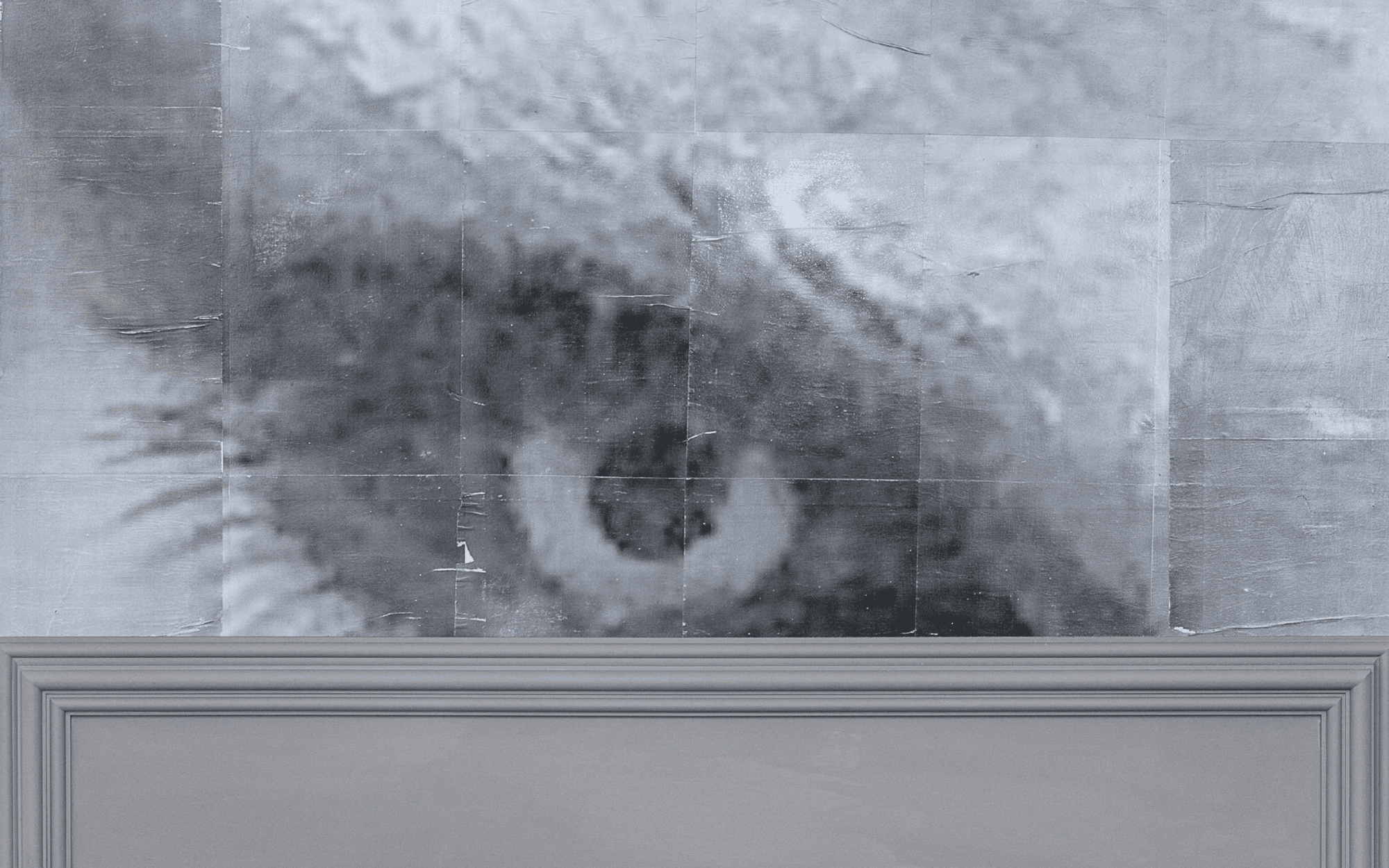
Philipp Timischl is one of Austria’s most significant emerging artists, advancing a distinctive practice that engages a wide range of media and materials. In transformations of topical images, Timischl processes personal and critical reactions to the impressions and challenges of an everyday life increasingly shaped by forms of populism and a lack of orientation. The artist has created his most recent cycle of works as a new production for the exhibition series Future of Melancholia. For Molded, Timischl created nine paintings that intentionally break with stylistic consistency, deliberately playing with artistic authorship. The exhibition title, Molded, which can mean both “formed” and “decayed,” reflects a shifting focus within the artist’s serial production process. Each painting in the series adopts a distinct visual style: one is text-based, another incorporates a collaged SKIMS advertising poster, while another features a gray, concrete-like texture, and a further oil painting shows a cloudy sky.
This intentional stylistic variety also has a number of unifying elements. The format of the works in Molded is identical, and they all have elaborate trims, so-called mouloura (wooden wall paneling), which gives the series the look of a construction set for wall coverings and recalls typically French interior design. These decorative frames and paneling, inspired by traditional craftsmanship but industrially produced, are attached to the lower sections of the canvases as a recurring sculptural element. Instead of a clearly identifiable artistic signature, the works are unified by their external structure, which in turn raises questions about authorship, identity, and artistic ownership.
In addition to the Molded series, Timischl is also showing the two works Monochrome Siblings (2024). On the lower quarter of canvases made of tadelakt, a traditional Moroccan wall finish, the artist has attached LED panels that communicate directly with the painting and with the idea of twins alluded to in the video. At first, the lower LED strip simply mirrors the colors of the canvas, creating the illusion of subtle motion. Soon, however, various pop-cultural and historical pairs appear, including the cartoon characters Chip n’ Dale, Hans Holbein’s the Younger’s ambassadors from his painting of the same name (The Ambassadors, 1533), Chucky, the murdering doll and his bride Tiffany, as well as Snoop Dogg und Martha Stewart. Here Timischl again draws on (pop-)cultural appropriation, this time more directly, but now the texts that he adds to the famous couples he depicts in the video are even more important. While Timischl’s appropriation is humorous, an underlying sense of melancholy remains.
What in particular matters is the allusion to the concept of the future, or rather its cancellation that Timischl refers to in his solo show within The Future of Melancholia. Here too, the definitions of the title Molded are significant, asking us questions of form and its transformation as well as its transience. Inherent to Timischl’s works is what is often called the uncanny, with clear discomfort not only concerning a present-day increasingly tempered by melancholy but also the future.
Timischl’s series reflects Mark Fisher’s “slow cancellation of the future” (2013), which builds on Jacques Derrida’s concept of hauntology—the idea that cultural elements from the past persist like ghosts, continuously reappearing in the present. Fisher argues that modernity’s goal-driven understanding of time has collapsed into an endless loop of recycled cultural and social forms, making true innovation seem impossible. In stylistic terms too, Timischl works with this point of reference, by drawing on different styles and epochs and generating a form of temporal ambiguity, thus not merely engendering a sense of disorientation but also playing a game of chance with the ideas of authorship mentioned above. In particular his text-based painting on the dubious obligation to go to school witnesses the insecurity of our time, anticipating not just The Future of Melancholia but a melancholic future in which stability and continuity oscillate as seemingly unattainable goals.
Timischl’s intricate classical designs and the unified dimensions of these works set them into dialogue with one another, while evoking memories of industrial precision as well as a nostalgic look back at mechanical prints and the past in itself, whose borders to the present are blurred. Molded draws on pop-cultural symbols from the past, creating a visual language that embodies the melancholic idea of a “cancelled future.” Timischl’s series invites viewers into a fragmented world—his artefacts mirror a moment that swings between tradition and the contemporary, whereby the contemporary may already be the past.
Future of Melancholia is a cooperation of the Museum of Contemporary Art in Belgrade and HALLE FÜR KUNST Steiermark. This would not have been possible without the generous support of the Cultural Department of the State of Styria, the Austrian Federal Ministry for European and International Affairs (BMEIA), the Serbian Academy of Sciences and Arts and the Ministry of Culture of the Republic of Serbia. The project was initiated within the BMEIA program Imagine Dignity – Laboratories Of Hope: Regenerating Democratic Prosperity.
Future of Melancholia
Further exhibition spaces:
Gallery-Legacy of Milica Zorić & Rodoljub Čolaković, (MoCAB)
Rodoljuba Čolakovića 2, 11000 Belgrade
HALLE FÜR KUNST Steiermark
Burgring 2, 8010 Graz
https://halle-fuer-kunst.at/en/exhibitions/future-of-melancholia/


